Showing posts with label solar. Show all posts

Thursday

About The CHI Worldwide Center

Purpose
CHI Worldwide Center (CWC) will host people of all ages, providing tours, seminars, workshops, and outreach to promote and teach comprehensive integrative sustainability through the practice of permaculture farming and ranching, healthy living, weight-release, performance enhancement, recycling, zero waste architecture, and clean technologies. And lastly, CWC will provide retreats, homes, and rental properties for those who want the breathtaking peacefulness and life changing reinvigoration that truly harmonious living gives you, plus with the inherent security of our comprehensive sustainable philosophy and designs, you will be able to lay rest any fears and anxieties that the world of economic and environmental instability creates; knowing that in the midst of any instability, you have a safe, secure, and comfortable, but more to the point, sustainable place where you will prosper and enjoy life.

CWC Location
CWC will be located in Park County, Colorado. Within a few hours driving distance to Denver, Colorado Springs, and world-famous ski resort Breckrenridge. CWC is not only ideal for people wanting to commune more closely with nature, but also those who want to still be in somewhat close proximity to urban offerings. The high altitude of 8000+ feet makes CWCs location ideal for beatific mountain views, as well as solar and green energies; this region of Park County boasts over 300 days of sun annually.

CWC Facility
The CWC Retreat Center will be built and run using green, sustainable and environmentally sound principles, with a neutral carbon footprint and off-the-grid practices. CWC will be built using a combination of earth-sheltered, paramagnetic geodesic dome technology and sacred geometry, as these are the best-known ways of maintaining harmony with the environment. Sacred geometry and paramagnetic structures promote growth in seedlings, while the same exact seedlings die in conventional architecture and building materials. Additionally, earth-sheltered and geodesic dome buildings provides relief from exorbitant heating and cooling, as well as a decreased carbon footprint from energy expenditures, but utilizes sun and reflective technology for lighting. Earth-sheltered and dome buildings are also naturally resistant to human and natural disasters, as well as being naturally fire-, flood-, and pest-proof, so there is no need for the use of toxic chemicals. CWC plans to be a resource and example of sustainable building and living, and will host individuals studying green, environmental and eco-technology, lifestyle design, and zero point energy as well as those seeking to release weight, and achieve optimum health while simultaneously reconnecting and respecting the environment, the community, and themselves.


CWC Mission Statement
CWC's mission is to create, maintain, make profitable a space that disseminates tools, knowledge, and experiences that promote, support, and maintain individual, and community health and harmony with no other purpose than the integration of comprehensive sustainability through hands-on trainings, seminars, education, and products with the understanding that true comprehensive sustainability cannot be attained unless the individual is sustainable, internally and externally, and the participation of that individual in their culture and community is also sustainable, while at all times maintaining planetary and ecological sustainably through every aspect.

Comprehensive Sustainability & Their Technologies Employed At CWC

  • Aquaponics
  • Solar
  • Wind
  • DIY Tractors, Machinery, & Equipment
  • Aviation
  • Waste Recycling for Natural Gas
  • Steam energy
  • Extended Battery Technology
  • Permacuture Farming & Livestock
  • Water recycling: Grey, black water, and condensation collection
  • Vortex Water Purification
  • HHO & Electric Vehicle Technology
  • Sacred Geometry Construction
  • Geodesic, Paramagnetic Basalt-based Domes
  • Sustainable Gardening and Personal Green Houses
  • DIY Beauty and Household Products

CWC’s View of Integrative Sustainability
The design and use of human, technological, and natural resources, while ensuring humankind’s use of earth’s resources do not lead to diminished health or quality of life for this or future generations, diminished natural resources or adverse impact on economic opportunities, social conditions, human health and environment.

CWC’s Areas of Expertise
  • Creating Integrative Sustainability
  • Healthy Lifestyle Design
  • Organic Eating & Cooking
  • Urban Organic Gardening
  • Aquaponics
  • Urban Composting
  • Aviation
  • Renewable & Sustainable Energy
  • Nutrition & Fitness
  • Weight Loss
  • Yoga & Pilates
  • Martial Arts
  • Body Work
  • Documentary Film-making
  • Motivational Speaking
  • Hypnotherapy
  • Flotation Meditation & Visualization
  • Optimum Performance Enhancement
  • Composting
CWC Community,
Education, Outreach
&Accessibility
CWC will be home to and host people of all ages, providing tours, seminars, workshops, and outreach to promote and teach integrative sustainability, healthy living, and performance enhancement. Though CWC will host all ages, the focus will be on educating children in integrative sustainable living, so as to create in the upcoming generation a respect, love, and deep appreciation for nature, sustainable lifestyles, personal and environmental health.


CHI Community
Modeled with the philosophy that each individual's greatest contribution to their community is to be fully expressed as their individual selves, and that we are here to help and look out for one another, the CHI Community will be a growing populace of people wanting to emulate a more egalitarian and indigenous style of living in groups, while employing many modern technologies for effectiveness and convenience. The permanent, seasonal resident or weekend visitor of CHI will find all of their needs taken care of - meals, health care, utilities, entertainment, business, activities and transportation, CHI will be a truly all-inclusive, state-of-the-art, sustainable, and self-sufficient community. The current state of the world's relatively new practice of having and consuming more than you need is unsustainable and the notion that attaining one thing will make you happy, therefore two things will make you twice as happy is erroneous and ultimately self-destructive. The style of living where the health and well-being of your entire tribe is of the utmost importance was tried and tested for hundreds of thousands of years by indigenous populations all over the globe; CWC will be bringing this age-old wisdom of tribal living to the modern age. Think of an all-inclusive high-end resort that is actually ecological, sustainable and organic in all of its practices.

Sustainable Engineering Lab & Machine Shop
In alignment with CWC's mission statement, our state-of-the-art Lab will be home to many great inventors and technologies that work in harmony with the planet, and will aim to solve many of the detrimental issues related to energy and the by-products of modern society and its energy addiction and consumption. This is where the sustainable energies and technologies employed at CWC will be developed and improved with the purpose of creating cleaner, more self-contained communities worldwide. Additionally, the CWC Lab and Machine Shop will be equipped to repair and build anything the CWC may require - creating true comprehensive sustainability.

Urban Sustainability
Tours of eco-friendly, sustainable center, zero-waste building, earth-sheltered technology, as well as teaching how solar, wind, and hydro energies work, and create economic and employment opportunities inherent in sustainable building, living and community.

Sustainable Living Day Trip

Day-long tour and seminar to introduce and familiarize people with sustainable principles and techniques, created especially to demystify and integrate the ability to live in harmony with oneself and nature without sacrificing modern conveniences or cultural acceptability and adoption.

Organic Weight & Lifestyle Management
Ongoing and intensive workshops teaching healthy living principles including yoga, pilates, interval training, organic and sustainable gardening, eating and cooking. The intention is to learn in a beautiful, natural, mountain environment and gain an appreciation for being healthy in nature, therefore reinforcing the desire and connection for sustainable, healthful living.

Urban Fit
Ongoing and intensive workshops teaching how to live a more sustainable lifestyle in modern and urban society by teaching urban gardening, urban sustainability and meditative practices that will create and promote earth-friendly harmonious living. http://www.unreasonablehappinessonline.com

Mountain Fit
How to identify, survive and thrive in a wilderness environment utilizing CWC’s 40-acres as well as nearby reserves, state and national parks to promote a greater connection, understanding, and ease with nature.

Wilderness Survival
How to identify, survive and thrive in a wilderness environment utilizing CWC’s 40-acres as well as nearby reserves, state and national parks to promote a greater connection, understanding, and ease with nature.


Isolation Flotation Tank Meditation & Visualization
Everyone can benefit from the deep meditation achieved through sensory deprivation. CWC will greatly benefit olympic athletes and high-performance individuals interested in performance enhancement inherent in utilizing cutting-edge sensory deprivation, hypnosis, visualization and auditory training to achieve personal, athletic business goals, and increased performance.

Transformational Fighting Arts (TFA)

Ongoing and intensive martial arts classes, taught in a beautiful, natural setting to create connection with the environment and yourself. TFA draws from 30 ancient, classical and modern systems including Tai Chi, Qi Gong, Kung Fu, Jeet Kune Do (Bruce Lee), Ba Kua, Aikido, Kali, and Ju Jitsu. Sifu Marcus, the head instructor, has over 20 years of experience, and though most of these systems don’t have belts or ranking, he would have the equivalent of a 9th degree black belt. http://www.transformationalfightingartsonline.com

Vision Quest
One to two-week intensive rehabilitation workshops that integrate all CWC has to offer, including meditation, visualization, hypnotherapy, flotation, yoga, martial arts, body-work, wilderness survival, organic eating and cooking, discovering your purpose within a sustainable ecology, spiritual and physical performance enhancement, training in sustainable lifestyle, and integrating spiritual and sustainability principles into everyday, modern living. http://www.masterytrainingsystems.com/

Sustainable Media Center

A fully functional production studio, media center, and editing facility able to broadcast and produce the highest quality documentaries, films, interviews, and web content. The CWC Media Center will be run with the philosophy that interconnectedness and communication are paramount, specifically during unforeseen environmental and world events. What sets our media center apart and makes it sustainable is that we will take precautions, and have protections and back-ups in place so that we may still operate and broadcast regardless of the aforementioned events.

Bionomic Airfield & Helipad

Nestled on CWC's scenic valley with easy and convenient access to Colorado Springs and Denver airports. With future plans to fly and maintain bio-diesel aircraft, and many other types of cutting-edge planes that utilize alternative fuel.


“It’s not about knowing it; it’s about living it.”
-Marcus Lovemore

Chi Worldwide Center
info@chiworldwide.org
http://www.chiworldwide.org
(310) 526-8606
Marcus Lovemore, Co-Founder
Katie Strand, Co-Founder

Monday

The Dark Side Of Solar Panels

The Los Angeles Times reports that we may be trading one evil for another with all of the potential waste generated from the life-cycle of a solar panel. While maybe not as harmful as mountaintop removal from coal or emissions emitted from the millions of cars on the road, the generation of electricity from solar does have its own dark side.Huge amounts of fossil fuels are used in the manufacture of the cells and, just like many other electronics, the waste metals not used in production also present their own disposal problems, mercury and chromium being two of the top problem-makers. We've also reported before that the installation of solar panels also includes toxic materials like the PVC and glues used in the conduit.

How Do We Know There is a Problem?

By looking at Asia, one of the leaders in solar applications, we see an area that is starting to have disposal problems from the use of all of the toxins during manufacture. In addition, the electronics industry generated 2.6 million tons of waste in 2005, most of which was ditched in landfills or incinerators, or shipped to developing nations for disposal. Meaning that either way it leached into groundwater, harmed the air or directly harmed people during the dismantling.

Friday

Solar Flare News -Videos


Solar Fares For Beginners

Sometimes a sudden, rapid, and intense variation in brightness is seen on the Sun. That is a solar flare. A solar flare occurs when magnetic energy that has built up in the solar atmosphere is suddenly released. On the Sun's surface are huge magnetic loops called prominences. When they touch, they short circuit each other, setting off explosions. The amount of energy released is the equivalent of millions of 100-megaton hydrogen bombs exploding at the same time! A solar flare contains high energy photons and particles, and is released from the Sun in a relatively short amount of time (a few minutes).

Discovery Channel
documentary on a possible scenario for a solar storm disaster


NASA Physicist, Ph.D./Theoretical Physics, University of Helsinki, Finland Antti Pulkkinen predictions for solar flares.


Professor of Theoretical Physics Micho Kaka of the City College of New York City, New York University, and the co-founder of the string field theory explains the likely effects of the upcoming solar flares.


Sunday

NASA Explains What Would Happen if the 1921 Solar Flare Hit Today

This an excerpt from a 132-page NASA funded report titled Severe Space Weather Event - Understanding Societal and Economic Impacts, suggests that the right magnitude storm could be devastating:

The problem begins with the electric power grid. “Electric power is modern society’s cornerstone technology on which virtually all other infrastructures and services depend,” the report notes. Yet it is particularly vulnerable to bad space weather. Ground currents induced during geomagnetic storms can actually melt the copper windings of transformers at the heart of many power distribution systems. Sprawling power lines act like antennas, picking up the currents and spreading the problem over a wide area. The most famous geomagnetic power outage happened during a space storm in March 1989 when six million people in Quebec lost power for 9 hours.

According to the report, power grids may be more vulnerable than ever. The problem is interconnectedness. In recent years, utilities have joined grids together to allow long-distance transmission of low-cost power to areas of sudden demand. On a hot summer day in California, for instance, people in Los Angeles might be running their air conditioners on power routed from Oregon. It makes economic sense,”but not necessarily geomagnetic sense. Interconnectedness makes the system susceptible to wide-ranging “cascade failures.”

To estimate the scale of such a failure, report co-author John Kappenmann of the Metatech Corporation looked at the great geomagnetic storm of May 1921, which produced ground currents as much as ten times stronger than the 1989 Quebec storm, and modeled its effect on the modern power grid. He found more than 350 transformers at risk of permanent damage and 130 million people without power. The loss of electricity would ripple across the social infrastructure with “water distribution affected within several hours; perishable foods and medications lost in 12-24 hours; loss of heating/air conditioning, sewage disposal, phone service, fuel re-supply and so on.

“The concept of interdependency,” the report notes, “is evident in the unavailability of water due to long-term outage of electric power–and the inability to restart an electric generator without water on site.”

see caption

What if the May 1921 superstorm occurred today? A US map of vulnerable transformers with areas of probable system collapse encircled. A state-by-state map of transformer vulnerability is also available: click here.

The potential for major disruptions to our lives and our modern day just-in-time delivery systems could lead to total chaos in affected areas:

“A contemporary repetition of the Carrington Event would cause an extensive social and economic disruptions,” the report warns. Power outages would be accompanied by radio blackouts and satellite malfunctions; telecommunications, GPS navigation, banking and finance, and transportation would all be affected. Some problems would correct themselves with the fading of the storm: radio and GPS transmissions could come back online fairly quickly. Other problems would be lasting: a burnt-out multi-ton transformer, for instance, can take weeks or months to repair. The total economic impact in the first year alone could reach $2 trillion, some 20 times greater than the costs of a Hurricane Katrina or, to use a timelier example, a few TARP


Friday

Solar Flare Effects on the Grid

Newly discovered evidence by NASA predicts that a super solar storm coming in mid-May 2012, which occurred on Earth in 1805, could occur again and knock out all electricity on the planet, taking us back 100 years.

Prior to 2006, researchers at NASA and other similar think-tanks discovered strong evidence that a solar storm is coming–and this week the most intense solar maximum in fifty years has been detected. The facts are starting to grow.

The prediction has been issued by a team led by Mausumi Dikpati of the National Center for Atmospheric Research (NCAR). Dikpati’s prediction is unprecedented.

According to Dikpati “The next sunspot cycle will be 30% to 50% stronger than the previous one,” she says. If correct, the next solar maximum forecast for 2012 would be a global catastrophe–second only to the historic Solar Max of 1958 and 1805."

However, in 1958 and 1805 humans didn’t rely as much on technology as we do now. The entire economy and communications network of the world is dependent on these technologies–in a nutshell a solar flair would cripple us.

To seed where we are now, go to The Daily Solar Flare Daily Update window to the left. Also go the the Home page to find out how to prosper during the solar maximum this year.

NASA''s Concerns over the Solar Minimums

This is an excerpt from NASA's site: NASA Science News: http://science.nasa.gov/science-news/science-at-nasa/2009/01apr_deepsolarminimum/

Deep Solar Minimum

April 1, 2009: The sunspot cycle is behaving a little like the stock market. Just when you think it has hit bottom, it goes even lower.

2008 was a bear. There were no sunspots observed on 266 of the year's 366 days (73%). To find a year with more blank suns, you have to go all the way back to 1913, which had 311 spotless days: plot. Prompted by these numbers, some observers suggested that the solar cycle had hit bottom in 2008.

Maybe not. Sunspot counts for 2009 have dropped even lower. As of March 31st, there were no sunspots on 78 of the year's 90 days (87%).

It adds up to one inescapable conclusion: "We're experiencing a very deep solar minimum," says solar physicist Dean Pesnell of the Goddard Space Flight Center.

"This is the quietest sun we've seen in almost a century," agrees sunspot expert David Hathaway of the Marshall Space Flight Center.

see caption

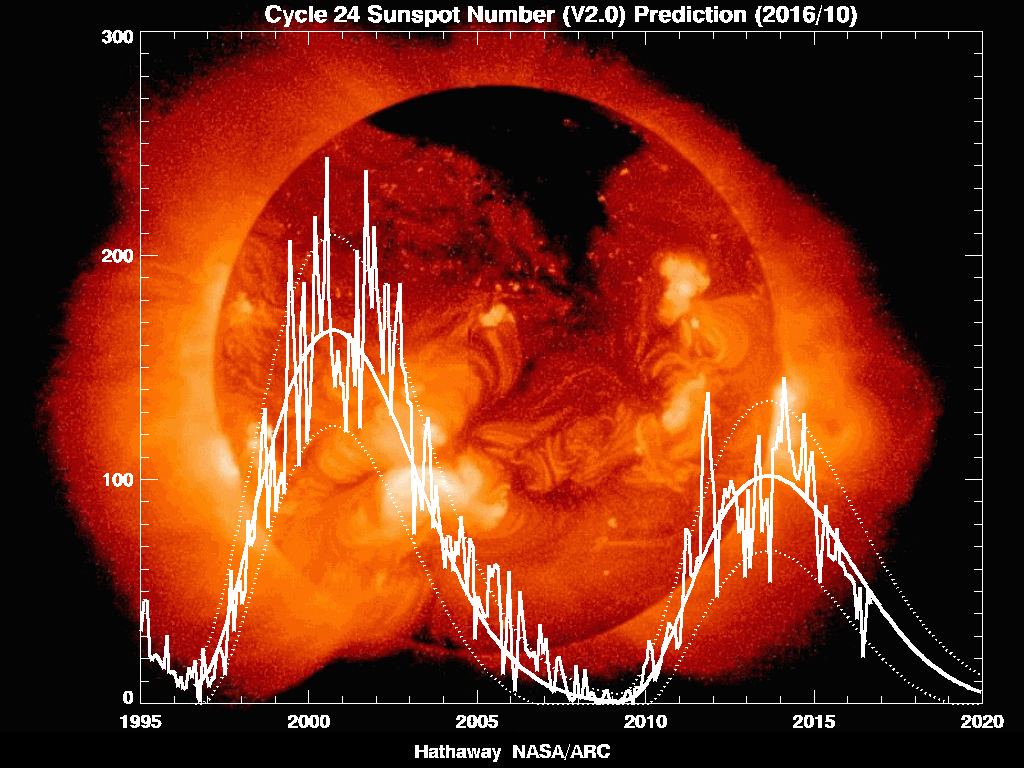
Above: The sunspot cycle from 1995 to the present. The jagged curve traces actual sunspot counts. Smooth curves are fits to the data and one forecaster's predictions of future activity. Credit: David Hathaway, NASA/MSFC. [more]

Quiet suns come along every 11 years or so. It's a natural part of the sunspot cycle, discovered by German astronomer Heinrich Schwabe in the mid-1800s. Sunspots are planet-sized islands of magnetism on the surface of the sun; they are sources of solar flares, coronal mass ejections and intense UV radiation. Plotting sunspot counts, Schwabe saw that peaks of solar activity were always followed by valleys of relative calm—a clockwork pattern that has held true for more than 200 years: plot.

The current solar minimum is part of that pattern. In fact, it's right on time. "We're due for a bit of quiet—and here it is," says Pesnell.


But is it supposed to be this quiet? In 2008, the sun set the following records:

A 50-year low in solar wind pressure: Measurements by the Ulysses spacecraft reveal a 20% drop in solar wind pressure since the mid-1990s—the lowest point since such measurements began in the 1960s. The solar wind helps keep galactic cosmic rays out of the inner solar system. With the solar wind flagging, more cosmic rays are permitted to enter, resulting in increased health hazards for astronauts. Weaker solar wind also means fewer geomagnetic storms and auroras on Earth.

A 12-year low in solar "irradiance": Careful measurements by several NASA spacecraft show that the sun's brightness has dropped by 0.02% at visible wavelengths and 6% at extreme UV wavelengths since the solar minimum of 1996. The changes so far are not enough to reverse the course of global warming, but there are some other significant side-effects: Earth's upper atmosphere is heated less by the sun and it is therefore less "puffed up." Satellites in low Earth orbit experience less atmospheric drag, extending their operational lifetimes. Unfortunately, space junk also remains longer in Earth orbit, increasing hazards to spacecraft and satellites.

see caption

Above: Space-age measurements of the total solar irradiance (brightness summed across all wavelengths). This plot, which comes from researcher C. Fröhlich, was shown by Dean Pesnell at the Fall 2008 AGU meeting during a lecture entitled "What is Solar Minimum and Why Should We Care?"

A 55-year low in solar radio emissions: After World War II, astronomers began keeping records of the sun's brightness at radio wavelengths. Records of 10.7 cm flux extend back all the way to the early 1950s. Radio telescopes are now recording the dimmest "radio sun" since 1955: plot. Some researchers believe that the lessening of radio emissions is an indication of weakness in the sun's global magnetic field. No one is certain, however, because the source of these long-monitored radio emissions is not fully understood.

All these lows have sparked a debate about whether the ongoing minimum is "weird", "extreme" or just an overdue "market correction" following a string of unusually intense solar maxima.

"Since the Space Age began in the 1950s, solar activity has been generally high," notes Hathaway. "Five of the ten most intense solar cycles on record have occurred in the last 50 years. We're just not used to this kind of deep calm."

Deep calm was fairly common a hundred years ago. The solar minima of 1901 and 1913, for instance, were even longer than the one we're experiencing now. To match those minima in terms of depth and longevity, the current minimum will have to last at least another year.

see captionIn a way, the calm is exciting, says Pesnell. "For the first time in history, we're getting to see what a deep solar minimum is really like." A fleet of spacecraft including the Solar and Heliospheric Observatory (SOHO), the twin STEREO probes, the five THEMIS probes, Hinode, ACE, Wind, TRACE, AIM, TIMED, Geotail and others are studying the sun and its effects on Earth 24/7 using technology that didn't exist 100 years ago. Their measurements of solar wind, cosmic rays, irradiance and magnetic fields show that solar minimum is much more interesting and profound than anyone expected.

To seed where we are now, go to The Daily Solar Flare Daily Update window to the left. Also go the the Home page to find out how to prosper during the solar maximum this year.

This next excerpt is again from the NASA site about what you just read has to do with the level solar flares yet to come.

Solar Maximum
&
Solar Minimum

Solar Maximum

The solar storm works in approximately an 11 year cycle. There is solar minimum (the least amount of solar storm) and solar maximum (the greatest amount). The last solar maximum was in 2001 and the last solar minimums was in 2006. The next solar max is predicted for 2012.

Solar Maximum 2012

An article was published on NASA’s website in 2006 (during the last solar minimum) titled Solar Storm Warning . This article by Science@NASA’s Dr. Tony Philips explains that the 2012 solar max will be the greatest since 1958 (when the Northern Lights were visible in Mexico).

“The next sunspot cycle will be 30% to 50% stronger than the previous one.” Mausumi Dikpati of the National Center for Atmospheric Research (NCAR)

The solar maximum image credit is to Lockheed Martin Solar & Astrophysics Lab, Yohkoh SXT and Kitt Peak National Solar Observatory.

Sunday

Glossary

Bamboo Construction
  • In its natural form, bamboo as a construction material is traditionally associated with the cultures of South Asia, East Asia and the South Pacific, to some extent in Central and South America and by extension in the aesthetic of Tiki culture. In China and India, bamboo was used to hold up simple suspension bridges, either by making cables of split bamboo or twisting whole culms of sufficiently pliable bamboo together. One such bridge in the area of Qian-Xian is referenced in writings dating back 960 A.D. and may have stood since as far back as the 3rd century B.C., due largely to continuous maintenance.[18] Bamboo has also long been used as scaffolding; the practice has been banned in China for buildings over six storeys but is still in continuous use for skyscrapers in Hong Kong.[19] In the Philippines, the nipa hut is a fairly typical example of the most basic sort of housing where bamboo is used; the walls are split and woven bamboo, and bamboo slats and poles may be used as its support. In Japanese architecture, bamboo is used primarily as a supplemental and/or decorative element in buildings such as fencing, fountains, grates and gutters, largely due to the ready abundance of quality timber.[20 Various structural shapes may be made by training the bamboo to assume them as it grows. Squared sections of bamboo are created by compressing the growing stalk within a square form.[21] Arches may similarly be created by forcing the bamboo's growth with the desired form, and costs much less than it would to assume the same shape in regular wood timber. More traditional forming methods, such as the application of heat and pressure, may also be used to curve or flatten the cut stalks.Bamboo can be cut and laminated into sheets and planks. This process involves cutting stalks into thin strips, planing them flat, boiling and drying the strips, which are then glued, pressed and finished.[23] Generally long used in China and Japan, entrepreneurs started developing and selling laminated bamboo flooring in the West during the mid 1990s;[23] products made from bamboo laminate, including flooring, cabinetry, furniture and even decorations, are currently surging in popularity, transitioning from the boutique market to mainstream providers such as Home Depot. The bamboo goods industry (which also includes small goods, fabric, etc.) is expected to be worth $25 billion by the year 2012.[24] The quality of bamboo laminate varies between manufacturers and the maturity of the plant from which it was harvested (six years being considered the optimum); the sturdiest products fulfill their claims of being up to three times harder than oak hardwood, but others may be softer than standard hardwood. Bamboo intended for use in construction should be treated to resist insects and rot. The most common solution for this purpose is a mixture of borax and boric acid.[25] Another process involves boiling cut bamboo to remove the starches that attract insects.

    Bamboo has been used as reinforcement for concrete in those areas where it is plentiful, though dispute exists over its effectiveness in the various studies done on the subject. Bamboo does have the necessary strength to fulfil this function, but untreated bamboo will swell from the absorption of water from the concrete, causing it to crack. Several procedures must be followed to overcome this shortcoming.[26]

    Several institutes, businesses, and universities are working on the bamboo as an ecological construction material. In the United States and France, it is possible to get houses made entirely of bamboo, which are earthquake and cyclone-resistant and internationally certified. In Bali, Indonesia, an international primary school, named the Green School, is constructed entirely of bamboo, due to its beauty, and advantages as a sustainable resource. There are three ISO standards for bamboo as a construction material.

    In parts of India, bamboo is used for drying clothes indoors, both as the rod high up near the ceiling to hang clothes on, as well as the stick that is wielded with acquired expert skill to hoist, spread, and to take down the clothes when dry. It is also commonly used to make ladders, which apart from their normal function, are also used for carrying bodies in funerals. In Maharashtra, the bamboo groves and forests are called VeLuvana, the name VeLu for bamboo is most likely from Sanskrit, while Vana means forest.

    Furthermore, bamboo is also used to create flagpoles for saffron-coloured, Hindu religious flags, which can be seen fluttering across India, especially Bihar and Uttar Pradesh, as well as in Guyana and Suriname.

    Bamboo is used for the structural members of the India pavilion at Expo 2010 in Shanghai. The pavilion is the world’s largest bamboo dome, about 34 m in diameter, with bamboo beams/members overlaid with a ferro-cement slab, water proofing, copper plate, solar PV panels, a small windmill and live plants. A total of 30 km of bamboo were used. The dome is supported on 18-m-long steel piles and a series of steel ring beams. The bamboo was treated with borax and boric acid as a fire retardant and insecticide and bent in the required shape. The bamboo sections are joined with reinforcement bars and concrete mortar to achieve necessary lengths.[27]

Paramagnetic
  • Paramagnetism is a physical force. It is the driving force behind Structured Water, the KIVA Lights and the Purple Plates. Not a hard-to-grasp spiritual essence, but a force that is identified and detailed in every physics handbook in the world. The knowledge of this force by the ancients is indisputable.

Exactly what in plain language, does this definition of paramagnetism mean?

First we must define the term magnetic moment. If you spin a fixed magnet in the center of a loop of wire, you generate electricity in the wire, creating an electric generator. Magnetic moment is the ration between the maximum torque exerted on a magnet or current-carrying coil, or the charge in a magnetic field, and the strength of the field itself. Since atoms and molecules spin, rotate, and vibrate in all kinds of predictable directions depending on their makeup, they are in effect, little dynamic generators displaying both field strength and torque (torque = rotating power in a mechanism). In summary, magnetic moment is the ratio of the strength of the magnetic field to rotating power.

It is obvious that the earth and cosmos itself has a magnetic moment since it has a low-energy magnetic field of about ½ gauss. Gauss is the CGS unit of magnetic flux. CGS means Centimeter, Grams, Seconds. Put quite simply, if you have one gram of a substance, on centimeter from a magnet, in what part of one second will it move to the magnet? Put another way, what weight of a paramagnetic material will move one centimeter to a magnet in one second?

Any substance, including soil or rock, that will move toward a magnet is paramagnetic. If you can measure the CGS of a substance then you will know the measure of its attractance force to magnet. CGS is known as susceptibility because it is obvious that if a substance moves to a magnet, then it is susceptible to a magnetic field. Other ways to say it are that the substance is attracted to magnet field, or resonating to the field or grabbed hold of by the field, or even loves the field!

If a paramagnetic substance is placed in a strong magnetic field, all of the field lines will eventually line up, as illustrated:

disordered energy ordered energy

In nature, all substances are in a weak cosmic magnetic field, which is the earth's ever-present ½ gauss, therefore they are aligned thus:

weakfield paramagnetic effects

They are then not completely random, or, as mathematicians might say, in a complete chaotic arrangement. That is why chaotic mathematics is so important to a study of paramagnetism. Take heed chaotic mathematicians. Once place in a strong magnetic field like the electromagnetic coil of a CGS meter, they become more aligned. The measure of the more aligned is the measure of the paramagnetic force, or the CGS measure.

Now that we know that paramagnetism is the alignment of a force field in one direction by a substance in a magnetic field, then we must ask, what is diamagnetism? The Dictionary of Chemistry defines diamagnetism as follows: "Diamagnetism is the magnetization in the opposite direction to that of the applied magnetic field, e.g., the susceptibility is negative away from the magnetic field." Actually all substances are diamagnetic, but it is a weak form of magnetism and may be masked by other, stronger forces, for instance a magnetic field.

Diamagnetism results from changes induced in the torque by bits of electrons that oppose the applied magnetic flux. There is thus a weak negative susceptibility to the magnet. Most organic compounds, including all plants, are diamagnetic. If plants are diamagnetic and good growing soil paramagnetic, then we must be dealing with the yin and yang of Chinese and Japanese geomancy, or the energy put forth by the crane and turtle rock formation.

Why are the crane and turtle rock important? Simply because most of the ancient Zen gardens that I have observed over the years appeared to be both paramagnetic/crane and diamagnetic/turtle! This was observed and documented in the Secret Book of Gardening. The diamagnetic properties of the flattened turtle rock are visually obvious by the amount of white quartz in it. One does not chip pieces of beautiful Zen garden rock to study its CGS properties, but most quartz is not only recognizable by sight, it is also either neutral or weakly diamagnetic.

The Nanzen-en stroll garden of the Kamakura period has several high granite and low quartz boulder arrangements as does the Ryogen-en garden designed by Soami. The diamagnetic/paramagnetic, or yin/yang arrangement is most often seen in the double crane and turtle configurations. There is also a triple configuration that has a central granite standing rock and two smaller granite paramagnetic lower rocks. Tentoku-en, the landscape garden of the Momoyama period, has a high crane basalt rock and low turtle limestone rock. Around these rocks an arrangement of Chinese bellflowers grows in profusion. Interestingly enough, they grow to the left of the tall basalt crane rock and on the right side of the flatter turtle rock.

By positioning such rocks in relationship to the sun and to each other, one can control plant growth. Apparently the ancients knew about this yin and yang, diamagnetic/paramagnetic phenomenon and utilized it in their Zen gardens. That such knowledge is now lost is demonstrated by the fact that the crane/turtle arrangement found at the elegant restaurant where my friend and I had dinner was composed of stones that were both paramagnetic and not paramagnetic/diamagnetic.

Before we move on to a discussion of atmospheric ELF radio waves, it is important that we also define magnetism (ferromagnetism). Ferro means iron. Magnetism occurs in ferro-magnetic substances because it is a characteristic of certain metals, particularly iron, at certain temperatures. Below a certain temperature, called the Curie point, an increasing magnetic field applied to iron, or any ferromagnetic substance, will cause increasing magnetization to a value so high that it becomes saturated and remains permanently stored, aligned magnetic moment. It is analogous to a stored DC battery.

Magnetic substances are extremely rare in nature, the best known being the mineral magnetite. Because of the rarity of magnetite, it is not apt to be the growing force of nature. That does not mean that magnetism is unimportant in the scheme of life.

In this regard, there is one last point that should be made. Even though magnetism is a fixed force, it does vary slightly. There is no such thing as flat line DC - everything in nature alternates, at least slightly. The simple fact is that the magnetic field of the cosmos and the earth alternates far more than the field of a fixed DC magnet. It is this alternating earth/cosmic field to which volcanic soil and volcanic rock resonate, or to which both are susceptible.

As in the case of plants, water is diamagnetic. The atmosphere, because of the oxygen, is paramagnetic. Some of my preliminary experiments at night, during the full moon, indicate a paramagnetic/diamagnetic, plant, moon, water and soil relationship in nature. We know that the moon, which is highly paramagnetic, has a very strong effect on tides, which are of diamagnetic water. The many volcanic and/or meteorite cones indicate a paramagnetic moon body even though I could find no data on this subject from moon rock measurements.

It has long been known that certain Indian tribes planted by the full moon. There is little doubt in my mind that the American Indian knew more about good agriculture techniques than modern agriculturists! As the Sioux brave remarked while watching a farmer turning under virgin prairie grass, "wrong side up!" (in Altars of Unknown Stone by Wes Jackson).

Sacred Geometry
  • The study of sacred geometry has its roots in the study of nature, and the mathematical principles at work therein[3]. Many forms observed in nature can be related to geometry, for example, the chambered nautilus grows at a constant rate and so its shell forms a logarithmic spiral to accommodate that growth without changing shape. Also, honeybees construct hexagonal cells to hold their honey. These and other correspondences are seen by believers in sacred geometry to be further proof of the cosmic significance of geometric forms. These phenomena can be explained through natural principles.[4

    The golden ratio, geometric ratios, and geometric figures were often employed in the design of Egyptian, ancient Indian, Greek and Roman architecture. Medieval European cathedrals also incorporated symbolic geometry. Indian and Himalayan spiritual communities often constructed temples and fortifications on design plans of mandala and yantra.

    Many of the sacred geometry principles of the human body and of ancient architecture have been compiled into the Vitruvian Man drawing by Leonardo Da Vinci, itself based on the much older writings of the roman architect Vitruvius.

    A contemporary usage of the term sacred geometry describes assertions of a mathematical order to the intrinsic nature of the universe. Scientists see the same geometric and mathematical patterns as arising directly from natural principles.

    Among the most prevalent traditional geometric forms ascribed to sacred geometry are the sine wave, the sphere, the vesica piscis, the torus (donut), the 5 platonic solids, the golden spiral, the tesseract (4-dimensional cube), Fractals[5] and the star tetrahedron (2 oppositely oriented and interpenetrating tetrahedrons) which leads to the merkaba.


Solar Flares

  • A sudden brightening observed over the Sun surface or the solar limb, which is interpreted as a large energy release of up to 6 × 1025 joules of energy[1] (about a sixth of the total energy output of the Sun each second). The flare ejects clouds of electrons, ions, and atoms through the corona into space. These clouds typically reach Earth a day or two after the event.[2] The term is also used to refer to similar phenomena in other stars, where the term stellar flare applies.
  • Solar flares affect all layers of the solar atmosphere (photosphere, chromosphere, and corona), when the medium plasma is heated to tens of millions of kelvins and electrons, protons, and heavier ions are accelerated to near the speed of light. They produce radiation across the electromagnetic spectrum at all wavelengths, from radio waves to gamma rays, although most of the energy goes to frequencies outside the visual range and for this reason the majority of the flares are not visible to the naked eye and must be observed with special instruments. Flares occur in active regions around sunspots, where intense magnetic fields penetrate the photosphere to link the corona to the solar interior. Flares are powered by the sudden (timescales of minutes to tens of minutes) release of magnetic energy stored in the corona. The same energy releases may produce coronal mass ejections (CME), although the relation between CMEs and flares is still not well established. X-rays and UV radiation emitted by solar flares can affect Earth's ionosphere and disrupt long-range radio communications. Direct radio emission at decimetric wavelengths may disturb operation of radars and other devices operating at these frequencies. Solar flares were first observed on the Sun by Richard Christopher Carrington and independently by Richard Hodgson in 1859 [3] as localized visible brightenings of small areas within a sunspot group. Stellar flares have also been observed on a variety of other stars.
  • The frequency of occurrence of solar flares varies, from several per day when the Sun is particularly "active" to less than one every week when the Sun is "quiet", following the 11-year cycle (the solar cycle). Large flares are less frequent than smaller ones. Flares occur when accelerated charged particles, mainly electrons, interact with the plasma medium. Scientific research has shown that the phenomenon of magnetic reconnection is responsible for the acceleration of the charged particles. On the Sun, magnetic reconnection may happen on solar arcades – a series of closely occurring loops of magnetic lines of force. These lines of force quickly reconnect into a low arcade of loops leaving a helix of magnetic field unconnected to the rest of the arcade. The sudden release of energy in this reconnection is in the origin of the particle acceleration. The unconnected magnetic helical field and the material that it contains may violently expand outwards forming a coronal mass ejection.[4] This also explains why solar flares typically erupt from what are known as the active regions on the Sun where magnetic fields are much stronger on an average. Although there is a general agreement on the flares' causes, the details are still not well known. It is not clear how the magnetic energy is transformed into the particle kinetic energy, nor it is known how the particles are accelerated to energies as high as 10 MeV (Mega Electronvolt) and beyond. There are also some inconsistencies regarding the total number of accelerated particles, which sometimes seems to be greater than the total number in the coronal loop. We are unable to forecast flares, even to this day. Solar flares are classified as A, B, C, M or X according to the peak flux (in watts per square meter, W/m2) of 100 to 800 picometer X-rays near Earth, as measured on the GOES spacecraft. Each class has a peak flux ten times greater than the preceding one. Within a class there is a linear scale from 1 to 9 (multiplicative factor), so an X2 flare (2 x 10⁻⁴ W/m2) is twice as powerful as an X1 flare (10−4 W/m2), and is four times more powerful than an M5 flare (5 x 10⁻⁵ W/m2). The more powerful M and X class flares are often associated with a variety of effects on the near-Earth space environment. This extended logarithmic classification is necessary because the total energies of flares range over many orders of magnitude, following a uniform distribution with flare frequency roughly proportional to the inverse of the total energy. Stellar flares and earthquakes show similar power-law distributions.[5]Another flare classification is based on spectral observations. The scheme uses both the intensity and emitting surface. The classification in intensity is qualitative, referring the flares as: (f)aint, (n)ormal or (b)rilliant. The emitting surface is measured in terms of millionths of the hemisphere and is described below (The total hemisphere area AH = 6.2 × 10¹² km2.)