Showing posts with label storms. Show all posts

Sunday

NASA Explains What Would Happen if the 1921 Solar Flare Hit Today

This an excerpt from a 132-page NASA funded report titled Severe Space Weather Event - Understanding Societal and Economic Impacts, suggests that the right magnitude storm could be devastating:

The problem begins with the electric power grid. “Electric power is modern society’s cornerstone technology on which virtually all other infrastructures and services depend,” the report notes. Yet it is particularly vulnerable to bad space weather. Ground currents induced during geomagnetic storms can actually melt the copper windings of transformers at the heart of many power distribution systems. Sprawling power lines act like antennas, picking up the currents and spreading the problem over a wide area. The most famous geomagnetic power outage happened during a space storm in March 1989 when six million people in Quebec lost power for 9 hours.

According to the report, power grids may be more vulnerable than ever. The problem is interconnectedness. In recent years, utilities have joined grids together to allow long-distance transmission of low-cost power to areas of sudden demand. On a hot summer day in California, for instance, people in Los Angeles might be running their air conditioners on power routed from Oregon. It makes economic sense,”but not necessarily geomagnetic sense. Interconnectedness makes the system susceptible to wide-ranging “cascade failures.”

To estimate the scale of such a failure, report co-author John Kappenmann of the Metatech Corporation looked at the great geomagnetic storm of May 1921, which produced ground currents as much as ten times stronger than the 1989 Quebec storm, and modeled its effect on the modern power grid. He found more than 350 transformers at risk of permanent damage and 130 million people without power. The loss of electricity would ripple across the social infrastructure with “water distribution affected within several hours; perishable foods and medications lost in 12-24 hours; loss of heating/air conditioning, sewage disposal, phone service, fuel re-supply and so on.”

“The concept of interdependency,” the report notes, “is evident in the unavailability of water due to long-term outage of electric power–and the inability to restart an electric generator without water on site.”

see caption

What if the May 1921 superstorm occurred today? A US map of vulnerable transformers with areas of probable system collapse encircled. A state-by-state map of transformer vulnerability is also available: click here.

The potential for major disruptions to our lives and our modern day just-in-time delivery systems could lead to total chaos in affected areas:

“A contemporary repetition of the Carrington Event would cause an extensive social and economic disruptions,” the report warns. Power outages would be accompanied by radio blackouts and satellite malfunctions; telecommunications, GPS navigation, banking and finance, and transportation would all be affected. Some problems would correct themselves with the fading of the storm: radio and GPS transmissions could come back online fairly quickly. Other problems would be lasting: a burnt-out multi-ton transformer, for instance, can take weeks or months to repair. The total economic impact in the first year alone could reach $2 trillion, some 20 times greater than the costs of a Hurricane Katrina or, to use a timelier example, a few TARP



Friday

Solar Flare Effects on the Grid

Newly discovered evidence by NASA predicts that a super solar storm coming in mid-May 2012, which occurred on Earth in 1805, could occur again and knock out all electricity on the planet, taking us back 100 years.

Prior to 2006, researchers at NASA and other similar think-tanks discovered strong evidence that a solar storm is coming–and this week the most intense solar maximum in fifty years has been detected. The facts are starting to grow.

The prediction has been issued by a team led by Mausumi Dikpati of the National Center for Atmospheric Research (NCAR). Dikpati’s prediction is unprecedented.

According to Dikpati “The next sunspot cycle will be 30% to 50% stronger than the previous one,” she says. If correct, the next solar maximum forecast for 2012 would be a global catastrophe–second only to the historic Solar Max of 1958 and 1805."

However, in 1958 and 1805 humans didn’t rely as much on technology as we do now. The entire economy and communications network of the world is dependent on these technologies–in a nutshell a solar flair would cripple us.

To seed where we are now, go to The Daily Solar Flare Daily Update window to the left. Also go the the Home page to find out how to prosper during the solar maximum this year.

NASA''s Concerns over the Solar Minimums

This is an excerpt from NASA's site: NASA Science News: http://science.nasa.gov/science-news/science-at-nasa/2009/01apr_deepsolarminimum/

Deep Solar Minimum

April 1, 2009: The sunspot cycle is behaving a little like the stock market. Just when you think it has hit bottom, it goes even lower.

2008 was a bear. There were no sunspots observed on 266 of the year's 366 days (73%). To find a year with more blank suns, you have to go all the way back to 1913, which had 311 spotless days: plot. Prompted by these numbers, some observers suggested that the solar cycle had hit bottom in 2008.

Maybe not. Sunspot counts for 2009 have dropped even lower. As of March 31st, there were no sunspots on 78 of the year's 90 days (87%).

It adds up to one inescapable conclusion: "We're experiencing a very deep solar minimum," says solar physicist Dean Pesnell of the Goddard Space Flight Center.

"This is the quietest sun we've seen in almost a century," agrees sunspot expert David Hathaway of the Marshall Space Flight Center.

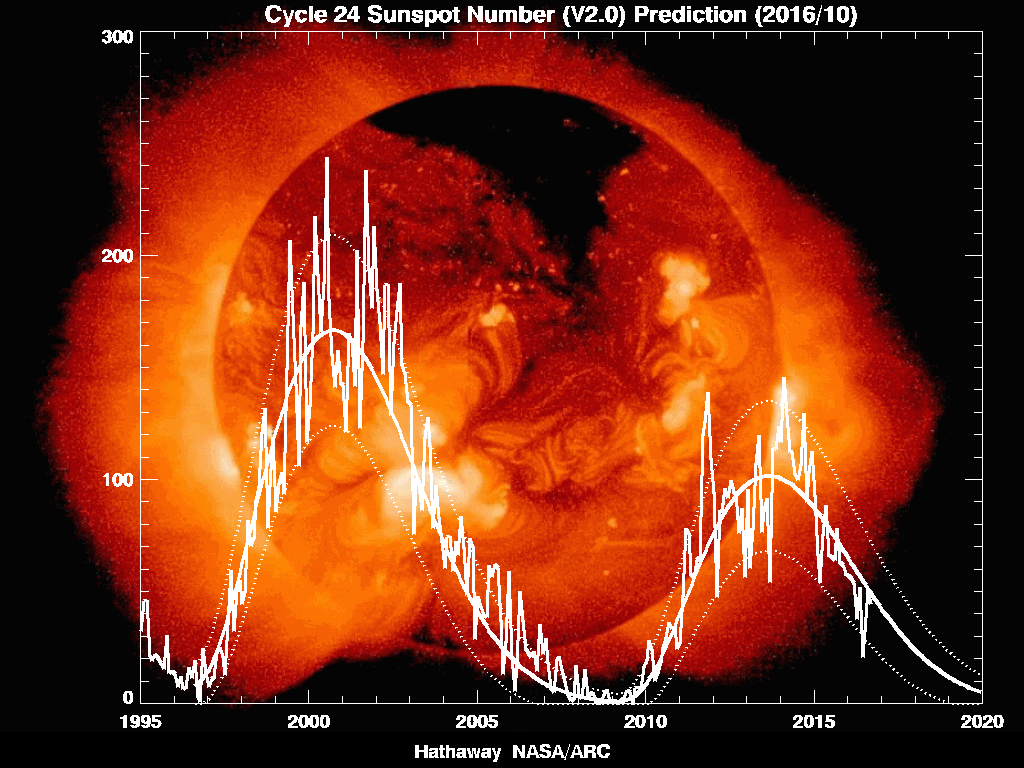
see caption

Above: The sunspot cycle from 1995 to the present. The jagged curve traces actual sunspot counts. Smooth curves are fits to the data and one forecaster's predictions of future activity. Credit: David Hathaway, NASA/MSFC. [more]

Quiet suns come along every 11 years or so. It's a natural part of the sunspot cycle, discovered by German astronomer Heinrich Schwabe in the mid-1800s. Sunspots are planet-sized islands of magnetism on the surface of the sun; they are sources of solar flares, coronal mass ejections and intense UV radiation. Plotting sunspot counts, Schwabe saw that peaks of solar activity were always followed by valleys of relative calm—a clockwork pattern that has held true for more than 200 years: plot.

The current solar minimum is part of that pattern. In fact, it's right on time. "We're due for a bit of quiet—and here it is," says Pesnell.


But is it supposed to be this quiet? In 2008, the sun set the following records:

A 50-year low in solar wind pressure: Measurements by the Ulysses spacecraft reveal a 20% drop in solar wind pressure since the mid-1990s—the lowest point since such measurements began in the 1960s. The solar wind helps keep galactic cosmic rays out of the inner solar system. With the solar wind flagging, more cosmic rays are permitted to enter, resulting in increased health hazards for astronauts. Weaker solar wind also means fewer geomagnetic storms and auroras on Earth.

A 12-year low in solar "irradiance": Careful measurements by several NASA spacecraft show that the sun's brightness has dropped by 0.02% at visible wavelengths and 6% at extreme UV wavelengths since the solar minimum of 1996. The changes so far are not enough to reverse the course of global warming, but there are some other significant side-effects: Earth's upper atmosphere is heated less by the sun and it is therefore less "puffed up." Satellites in low Earth orbit experience less atmospheric drag, extending their operational lifetimes. Unfortunately, space junk also remains longer in Earth orbit, increasing hazards to spacecraft and satellites.

see caption

Above: Space-age measurements of the total solar irradiance (brightness summed across all wavelengths). This plot, which comes from researcher C. Fröhlich, was shown by Dean Pesnell at the Fall 2008 AGU meeting during a lecture entitled "What is Solar Minimum and Why Should We Care?"

A 55-year low in solar radio emissions: After World War II, astronomers began keeping records of the sun's brightness at radio wavelengths. Records of 10.7 cm flux extend back all the way to the early 1950s. Radio telescopes are now recording the dimmest "radio sun" since 1955: plot. Some researchers believe that the lessening of radio emissions is an indication of weakness in the sun's global magnetic field. No one is certain, however, because the source of these long-monitored radio emissions is not fully understood.

All these lows have sparked a debate about whether the ongoing minimum is "weird", "extreme" or just an overdue "market correction" following a string of unusually intense solar maxima.

"Since the Space Age began in the 1950s, solar activity has been generally high," notes Hathaway. "Five of the ten most intense solar cycles on record have occurred in the last 50 years. We're just not used to this kind of deep calm."

Deep calm was fairly common a hundred years ago. The solar minima of 1901 and 1913, for instance, were even longer than the one we're experiencing now. To match those minima in terms of depth and longevity, the current minimum will have to last at least another year.

see captionIn a way, the calm is exciting, says Pesnell. "For the first time in history, we're getting to see what a deep solar minimum is really like." A fleet of spacecraft including the Solar and Heliospheric Observatory (SOHO), the twin STEREO probes, the five THEMIS probes, Hinode, ACE, Wind, TRACE, AIM, TIMED, Geotail and others are studying the sun and its effects on Earth 24/7 using technology that didn't exist 100 years ago. Their measurements of solar wind, cosmic rays, irradiance and magnetic fields show that solar minimum is much more interesting and profound than anyone expected.

To seed where we are now, go to The Daily Solar Flare Daily Update window to the left. Also go the the Home page to find out how to prosper during the solar maximum this year.

This next excerpt is again from the NASA site about what you just read has to do with the level solar flares yet to come.

Solar Maximum
&
Solar Minimum

Solar Maximum

The solar storm works in approximately an 11 year cycle. There is solar minimum (the least amount of solar storm) and solar maximum (the greatest amount). The last solar maximum was in 2001 and the last solar minimums was in 2006. The next solar max is predicted for 2012.

Solar Maximum 2012

An article was published on NASA’s website in 2006 (during the last solar minimum) titled Solar Storm Warning . This article by Science@NASA’s Dr. Tony Philips explains that the 2012 solar max will be the greatest since 1958 (when the Northern Lights were visible in Mexico).

“The next sunspot cycle will be 30% to 50% stronger than the previous one.” Mausumi Dikpati of the National Center for Atmospheric Research (NCAR)

The solar maximum image credit is to Lockheed Martin Solar & Astrophysics Lab, Yohkoh SXT and Kitt Peak National Solar Observatory.